Most generator set problems we are asked to troubleshoot were decided on the day the set was chosen. A set that is too small trips on block loads and never lets the voltage recover. A set that is far too large runs permanently under-loaded, never reaches operating temperature, and wears out its own engine through wet stacking and bore glazing.
The fix is the same in both directions: size the set from the application, then pick the model. This is how we approach it when specifying Sudong generator sets for Philippine sites.
01Start with the load, not the catalogue
Build a load list before you look at a single datasheet. Walk the site — or the vessel — and write down every load the set will carry:
- Each load's running power in kW, not just its nameplate rating
- Motors and their starting method — direct-on-line, star-delta, soft starter or VFD
- Which loads actually run at the same time, and which are standby for each other
- The load you expect to add in the next five years — a set outlives most expansions
Then apply a diversity factor: not everything runs simultaneously. But be honest about it — a hospital ward or a fish processing line has less diversity than an office, not more.
02kW, kVA and power factor
Generator sets are sold in kVA; your loads draw in kW. The bridge between them is power factor, and industrial alternators are conventionally rated at 0.8 PF.
A 500 kVA alternator at 0.8 PF delivers 400 kW. If your load list adds up to 400 kW of motors, chillers and lighting, the 500 kVA set is your starting point — not your finish line.
The finish line is a margin for starting transients, future load growth, and the fact that nameplate kW on equipment is often optimistic about real running conditions. In practice we look for 20–25% headroom above the diversified running load before calling a rating sufficient.
03Prime vs standby: the rating decision
This is the decision buyers most often get wrong, because the same physical set carries different ratings depending on the duty it is certified for.
- Prime power is for sites where the set is the main supply or runs long hours against a variable load — remote facilities, prime power for plants, long outage coverage. The set is rated to run essentially continuously, with the average load kept comfortably below the nameplate rating.
- Standby power is for emergency use: a set that runs only when the utility fails, for a limited number of hours per year. The nameplate number is higher for the same hardware because the duty is lighter.
The trap is buying on the standby number and then running the set as if it were prime. If the set is your primary supply — a resort on an island, a plant in an area with unstable utility feed — buy prime. If it exists to keep a hospital or a cold store alive during outages, standby is the right rating, and the hospital installations we have supplied in Palawan are exactly that duty: silent standby sets with automatic transfer switches that run when the grid does not.
04Derate for Philippine conditions
Ratings on a datasheet assume reference conditions — typically 25°C ambient at sea level. Philippine engine rooms and outdoor sites are not reference conditions.
- Heat. An engine room in Manila in April can hold ambient temperatures well above 40°C. Both the engine and the alternator deliver less as temperature rises, so a set that just fits at 25°C will not fit at 45°C.
- Altitude. Most Philippine sites are at or near sea level, so altitude derating rarely applies — but it matters for highland installations.
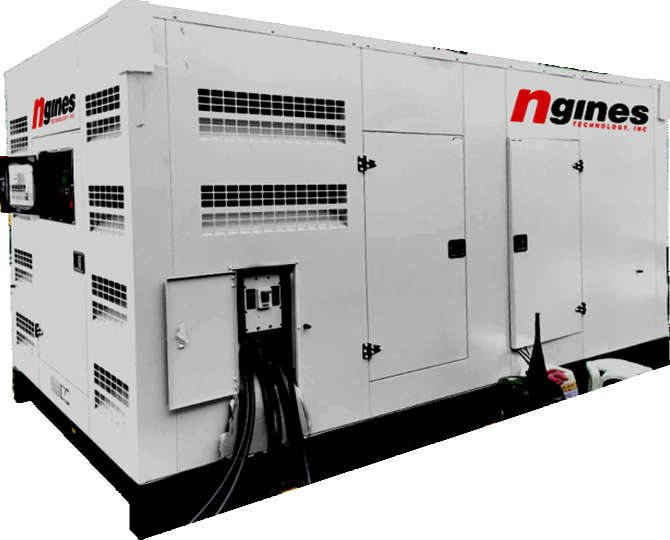
- Salt air. Coastal and island sites push you toward a proper enclosure, and the enclosure itself affects ventilation and therefore derating. We cover that trade-off in silent vs open generator sets.
05Motor starting and transients
The steady-state load is only half the study. The other half is what happens in the first second after a big motor closes its contactor.
A direct-on-line motor can draw several times its running current while accelerating. The set has to supply that inrush while keeping the voltage dip inside what your equipment tolerates — controllers and IT loads are far less forgiving than heaters. Where the dip would be too deep, the answers are a soft starter, a VFD, staged starting in the controller logic, or the next set size up.
Rule of thumb
If a single motor is more than a quarter of the set's kW rating, size the starting method deliberately. Do not rely on the set absorbing it.
06What to send us
You do not need to solve this alone — this is the engineering half of what we do. Send us:
- The load list: equipment, kW, power factor, starting method
- The duty: prime or standby, expected annual running hours
- The site: ambient temperature, indoor or outdoor, coastal exposure, altitude
- Whether you need an automatic transfer switch and the enclosure type
We will come back with the rating, the Sudong SDYK or CCFJ configuration, the alternator pairing and the control scheme — and the reasoning behind each choice. Request a quote with your load details and we will take it from there.